
Buyer Intent Signals vs Seller Activity in Traditional CRM

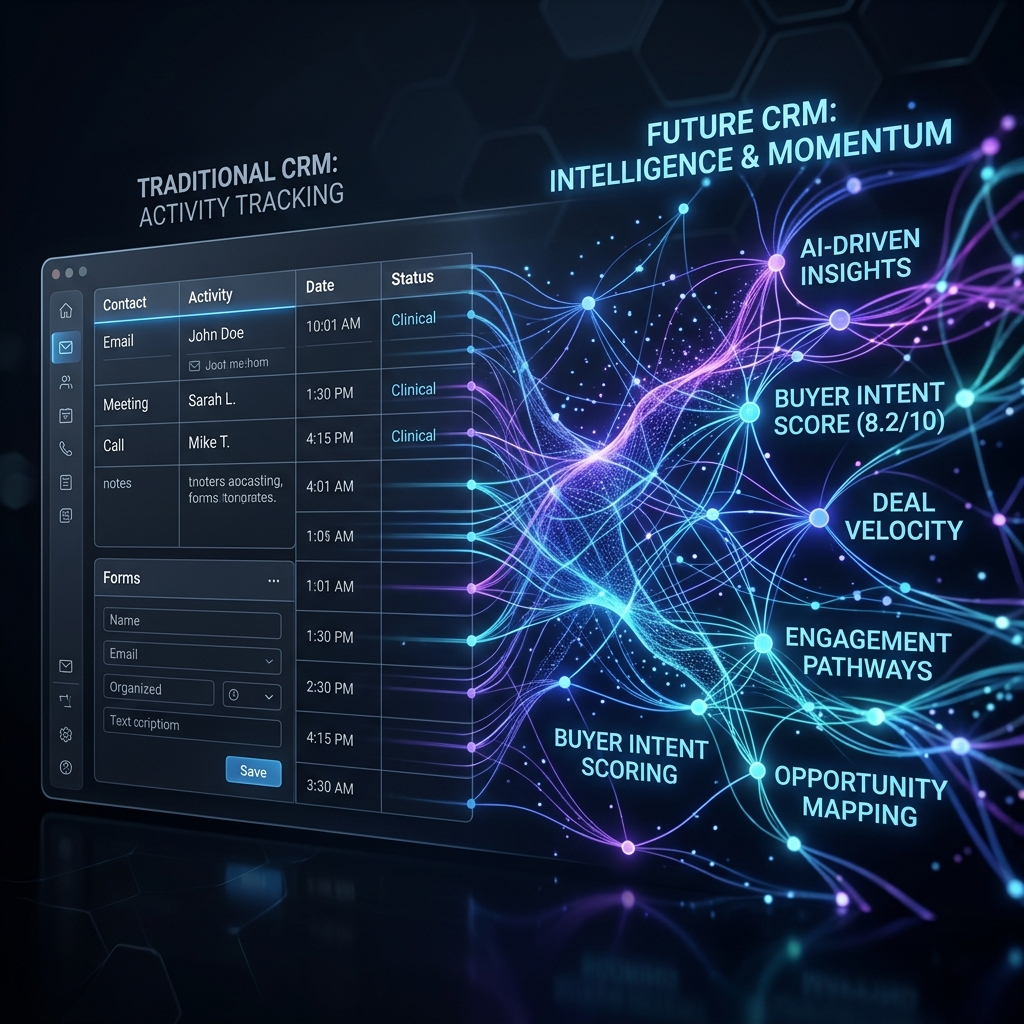
Key takeaways
- Traditional CRMs track observable seller behavior, creating a blind spot for silent shifts in buyer intent.
- AI-native CRMs are shifting from documentation to interpretation, using signals like stakeholder participation and email responsiveness to infer buyer conviction.
- The biggest challenge in enterprise sales is modeling organizational psychology from partial exhaust data, as much of the decision-making happens outside captured systems.
- The market is moving toward CRM as a commercial intelligence layer rather than just an administrative database, focusing on [how decisions are actually being shaped](/blog/crm-movement-vs-buying-decision) inside the account.
For the last 20 years, CRM systems were built around a simple assumption:
If seller activity increases, deal progression becomes more predictable.
More meetings. More emails. More next steps. More logged engagement.
The underlying logic made sense at the time. Enterprise sales was operationalized around rep execution because that was the only thing companies could reliably measure.
So CRM systems became structured timelines of seller behavior.
Did the AE follow up? Was the demo completed? Did procurement start? Was the MEDDPICC field updated? Did leadership review the opportunity?
The entire commercial system evolved around documenting motion.
But motion and intent were never the same thing.
That distinction is now becoming impossible to ignore.
The biggest blind spot in traditional CRM
Most enterprise deals don’t fail because activity disappears.
They fail because buyer intent changes silently.
And traditional CRMs were never designed to detect that.
A deal can look extremely healthy operationally while collapsing politically inside the buyer account.
The AE is multi-threaded. Meetings are happening weekly. Procurement is engaged. Security reviews are active. Leadership has visibility.
From the CRM’s perspective, the opportunity appears highly engaged.
But internally, the buying group may already be drifting toward:
- “This isn’t urgent anymore.”
- “We can delay until next quarter.”
- “The incumbent is good enough.”
- “Finance will push back.”
- “Nobody wants to sponsor this right now.”
None of those realities exist cleanly inside traditional CRM architecture.
Because CRMs were designed to track observable activity, not invisible organizational conviction.
That’s the structural shift AI-native CRM vendors are now chasing.
AI-native CRM systems are trying to infer commercial reality
The interesting shift is not automation.
It’s inference.
AI-native CRM companies are attempting to reconstruct buyer intent from fragmented behavioral signals:
- Stakeholder participation patterns
- Email responsiveness
- Meeting dynamics
- Cross-functional engagement
- Internal escalation velocity
- Executive involvement
- Buying-group expansion or contraction
- Tone changes across conversations
- Frequency shifts between interactions
The goal is no longer just documenting what sellers did.
The goal is estimating what buyers actually believe.
That’s a fundamentally different system.
Traditional CRMs acted like historical databases.
AI-native CRMs are trying to become probabilistic models of deal momentum. This is a massive departure from how snapshot systems assume stability while real buyer sentiment fluctuates.
That changes the role of the CRM entirely.
Why this gets much harder in enterprise deals
The challenge is that enterprise buying behavior rarely presents itself directly.
Especially in complex B2B environments.
Buyers almost never say:
“We are losing internal alignment.”
Instead, the signals become indirect.
A previously active stakeholder becomes passive. A security review slows down unexpectedly. An executive joins fewer meetings. Procurement engagement increases without strategic discussions progressing.
Traditional CRM systems interpret these as isolated events.
But experienced operators recognize them as pattern shifts.
This is where AI-native CRM vendors are placing their bet.
That enough fragmented signals can collectively reveal underlying buyer intent.
Sometimes that works surprisingly well.
But there’s still a major limitation.
The hardest part of enterprise sales still happens outside captured systems
The most important conversations in large deals often happen where no CRM has visibility.
Internal budgeting discussions. Political alignment. Leadership hesitation. Risk conversations. Competing initiatives. Executive sponsorship decay.
The buyer’s real decision-making process frequently unfolds entirely outside seller interaction.
Which creates the core problem for AI-native CRM systems:
They are trying to model organizational psychology from partial exhaust data.
That’s incredibly difficult.
Especially because enterprise buying groups themselves are often misaligned internally.
One stakeholder may appear highly engaged while another is actively deprioritizing the initiative behind the scenes.
The CRM sees engagement. The commercial reality is organizational fragmentation.
Those are not the same thing. Often, deal-critical context dies in conversations before it can even reach these analytical layers.
The CRM category is moving from documentation to interpretation
This is the real market transition happening underneath the AI-native CRM conversation.
Traditional CRM systems optimized for structured documentation.
AI-native CRM systems are optimizing for interpretation.
The winning systems will likely not be the ones that capture the most activity.
They’ll be the ones that best identify:
- whether buying consensus is strengthening or weakening
- whether urgency is compounding or fading
- whether stakeholder energy is expanding or collapsing
- whether the deal is becoming politically safer or riskier internally
That’s a very different problem than activity tracking. If you only focus on the surface, you'll find that activity is not progress.
And it explains why the CRM market suddenly feels unstable.
Because once the system starts interpreting buyer intent instead of recording seller workflow, the CRM stops behaving like infrastructure software.
It starts behaving like a commercial intelligence layer. This is why AI-native CRMs must move beyond being a repository and function as institutional memory for the entire commercial team.
That shift is much bigger than AI note-taking.
It changes what sales organizations believe the CRM is actually for.
FAQs
Common questions
Why do traditional CRMs fail to track buyer intent?
Traditional CRMs were designed to log seller activity (meetings, emails) because it's easily measurable. They lack the architecture to capture 'invisible' organizational conviction or silent shifts in alignment.
How do AI-native CRMs infer buyer intent?
They reconstruct intent by analyzing fragmented behavioral signals—stakeholder participation, meeting dynamics, tone changes, and buying-group expansion—to estimate what buyers actually believe.
What is the biggest limitation of AI-native CRM systems?
Much of the critical decision-making in enterprise deals happens internally, where no CRM has visibility. AI systems are essentially trying to model complex psychology from partial data.
How does the role of CRM change with AI?
CRM is moving from a historical documentation tool to a probabilistic model of deal momentum. It stops being infrastructure software and becomes a commercial intelligence layer.
Related reading
Continue exploring deal execution
AI-Native CRM as Institutional Memory for Revenue Teams
AI-native CRM should preserve deal reasoning, customer context, and team knowledge so revenue teams do not lose intelligence between meetings and handoffs.
Deal Context in Sales Conversations: Why CRM Summaries Miss Critical Signals
Critical deal context often lives in customer conversations, not CRM summaries. Learn why signals get lost and how that creates unpredictable deals.
Confidence Is Not Evidence: Why Commit Deals Miss the Forecast
Why commit deals often miss the forecast and how organizations can shift from subjective seller confidence to objective buyer-side milestones for accuracy.
Deal Memory vs CRM Data: Why Handoffs Break Enterprise Deals
CRM data shows fields and activity, but deal memory preserves reasoning, stakeholder context, and decisions that keep enterprise deals alive through handoffs.
Stakeholder Engagement vs Meeting Attendance in Buying Groups
Meeting attendance does not equal stakeholder engagement. Learn why silent buyers create hidden deal risk inside complex buying groups.