
Sales Activity vs Buyer Progress: Why Busy Deals Still Slip

Key takeaways
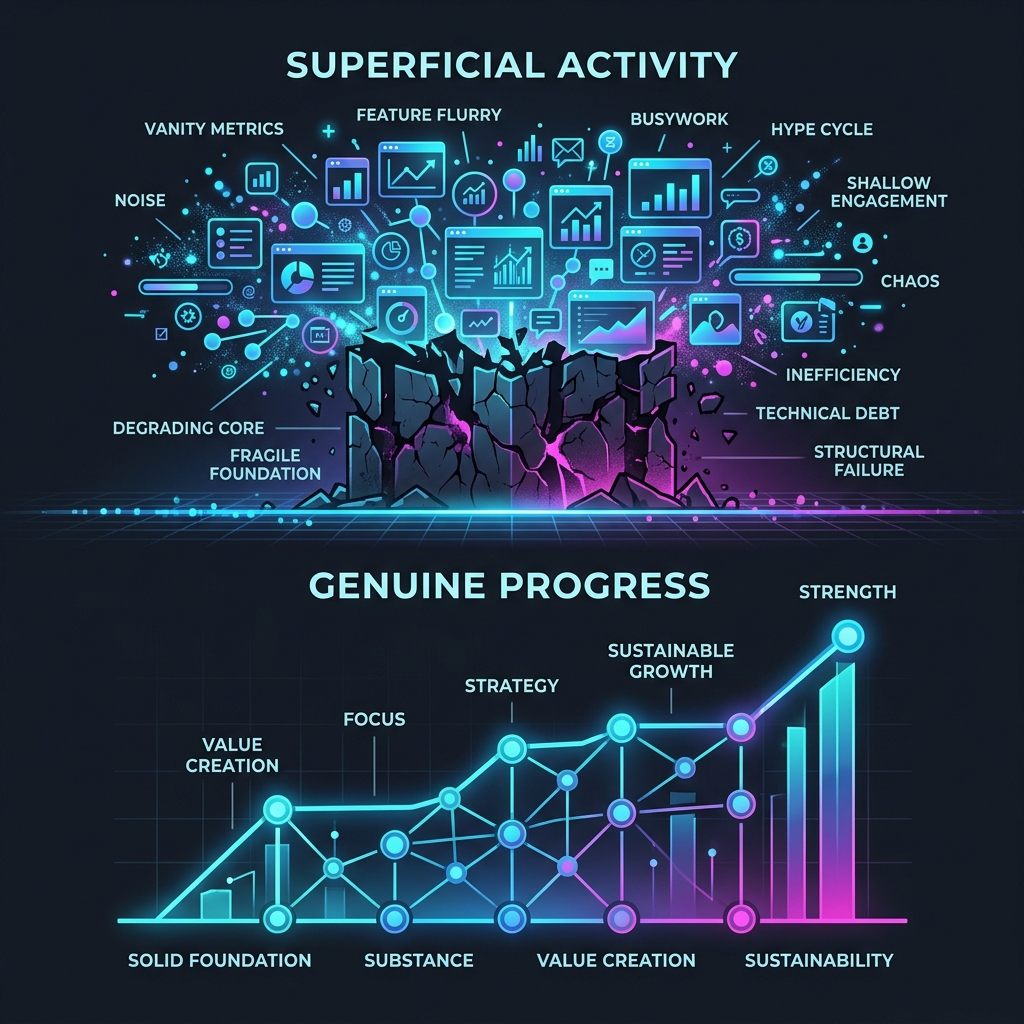
- Activity (calls, meetings, Slack threads) is not validation. Don't mistake motion for progress.
- Sales systems reward movement over accuracy, treating qualification as a one-time completed step rather than continuous validation.
- Qualification drift happens when new stakeholders and changing priorities quietly alter the deal's foundation without triggering requalification.
- When systems only focus on momentum, the gap between the perceived deal and the actual deal grows until it's too late to recover.
What is happening
Deals look alive.
There are calls every week. Stakeholders are engaged. Demos are happening. Slack threads are active. Internal deal chatter is constant.
From the outside, everything signals forward motion.
But underneath that activity, the core of the deal hasn’t been pressure-tested in weeks.
The original problem definition hasn’t been revisited. The buying group has changed. Priorities have shifted. New constraints have entered the picture.
None of that is reflected in how the deal is being qualified.
So the deal keeps moving. Stages progress. Forecast confidence increases.
But the actual integrity of the deal is quietly degrading.
Why this happens in real deals
Sales systems are designed to reward movement, not accuracy.
Reps are incentivized to keep deals progressing through stages. Managers inspect activity: number of meetings, stakeholder engagement, next steps.
Qualification, on the other hand, is treated as something you “complete” early.
Once MEDDICC fields are filled or discovery notes are logged, the system assumes those inputs remain valid.
But real deals don’t behave like that.
New stakeholders enter with different definitions of success. Internal priorities shift due to unrelated initiatives. Budget gets reallocated. Procurement introduces new constraints. Competitors reshape the narrative.
All of this changes the deal.
But none of it forces a re-qualification event inside the system.
So activity becomes the proxy for progress, because it’s the only thing consistently visible.
A realistic scenario
A deal starts strong with a Head of Operations.
Clear pain around inefficiency. Strong engagement. Weekly calls. A pilot is discussed early.
By mid-cycle, Finance gets involved.
Now the conversation shifts from operational efficiency to cost justification and ROI timelines.
At the same time, IT raises concerns about integration complexity that were never part of the initial discovery.
Calls increase. More stakeholders join. More documents are shared.
From a dashboard perspective, this deal looks like it’s accelerating.
But the original qualification was anchored on a single stakeholder’s pain and a loosely defined budget.
No one resets the qualification based on Finance’s criteria or IT’s constraints. When no one owns the decision, these constraints linger unresolved.
The deal advances to late stage.
Then stalls. Then slips. Then gets marked as “no decision.”
Not because activity stopped.
But because qualification never caught up with reality.
What this means for sales teams
Most teams are not losing deals because they lack activity.
They’re losing because they mistake activity for validation.
When systems and reviews focus on momentum signals, qualification becomes static by default—because snapshot systems assume stability while deals constantly change.
That creates a dangerous gap:
The deal you think you’re closing is not the deal that actually exists anymore.
And by the time that gap becomes visible, it’s usually too late to recover.
Qualification drift doesn’t look like risk.
It looks like progress. This is why CRM stages don't reflect real buying readiness.
That’s why it’s so hard to catch.
FAQs
Common questions
What is the difference between activity and progress in sales?
Activity refers to the volume of meetings, emails, and stakeholder involvement. Progress requires validation—ensuring the core problem, budget, and priorities remain aligned with the current state of the buying group.
Why does qualification drift go unnoticed?
Because it looks exactly like progress on a dashboard. The deal keeps moving through stages and generating activity, masking the fact that the underlying qualification criteria have changed or degraded.
How can sales reps prevent qualification drift?
Treat qualification as a continuous process, not a checklist. Re-validate the original problem definition and criteria every time a new stakeholder enters or a new constraint is introduced.
Related reading
Continue exploring deal execution
Why Static CRM Snapshots Create Hidden Deal Risk
CRM snapshots freeze a deal at one moment, but buyer priorities, stakeholders, and risks keep changing. Learn why static deal views mislead teams.
Decision Ownership in B2B Sales: Why Deals Stall Without an Internal Owner
Enterprise deals stall when everyone participates but no one owns the buying decision. Learn how decision ownership risk shows up in real deals.
Deal Context in Sales Conversations: Why CRM Summaries Miss Critical Signals
Critical deal context often lives in customer conversations, not CRM summaries. Learn why signals get lost and how that creates unpredictable deals.
Deal Narrative Drift: How Stakeholders Rewrite Momentum
Deal momentum changes when stakeholders reinterpret the problem, value, or urgency. Learn how narrative drift quietly weakens enterprise deals.
What Is a Deal Execution Platform? How It Differs From CRM
A deal execution platform helps revenue teams track real buyer progress, risks, stakeholders, and next actions beyond what a CRM records.