
AI-Native CRM as Institutional Memory for Revenue Teams

Key takeaways
- Traditional CRMs capture operational data (stages, meetings) but miss the predictive commercial context trapped in seller judgment.
- Commercial intelligence leaks through informal channels like Slack and voice notes, leading to a loss of deal narrative when ownership transitions.
- AI-native CRMs shift from documenting activity to preserving institutional memory by combining behavioral signals with human intuition.
- Preserving the 'why' and 'who' behind a deal creates a competitive advantage through better inspection and more reliable forecasting.
Most CRM systems were designed to answer operational questions.
What stage is the deal in? Who is the champion? When is the next meeting? Has procurement started?
Those questions matter.
But they miss the information that actually determines whether a complex deal closes.
Why does this initiative matter right now? Who is quietly resisting? Which executive is losing confidence? What political risk is increasing? Where is urgency weakening?
The most important commercial knowledge rarely lives in structured fields.
It lives in the rep's judgment.
And in most organizations, that judgment disappears.
Enterprise sales runs on context, not activity
Two opportunities can show identical CRM data.
Both have:
- Weekly meetings
- Multiple stakeholders
- Completed demos
- Active legal and procurement
- Positive call summaries
On paper, they look equally healthy.
But the underlying context can be completely different.
In one deal, the CFO is aligned, the champion is gaining influence, and the project is becoming more urgent.
In the other, budget is under pressure, executive sponsorship is fading, and stakeholders are engaging only to keep options open.
Traditional CRM systems store the same activity trail for both. This is how snapshot systems assume stability while masking the invisible shifts in organizational alignment.
The context that explains what is really happening remains trapped in the seller's head.
Why organizations lose deal intelligence
Commercial context leaks constantly.
It is discussed in:
- Manager one-on-ones
- Slack messages
- Forecast calls
- Voice notes
- Informal rep observations
"The champion is supportive but losing credibility internally."
"Procurement is moving, but finance has not committed."
"The executive sponsor is distracted by a larger initiative."
These are often the most predictive insights in the entire deal.
Yet they rarely become part of the system of record. When deal-critical context dies in conversations, the system becomes a lagging indicator of reality.
When the rep leaves, the manager changes, or ownership transitions, the organization loses the commercial story behind the opportunity.
The CRM preserves chronology.
It does not preserve judgment.
AI-native CRM changes the role of the system
The next generation of CRM is not just automating data entry.
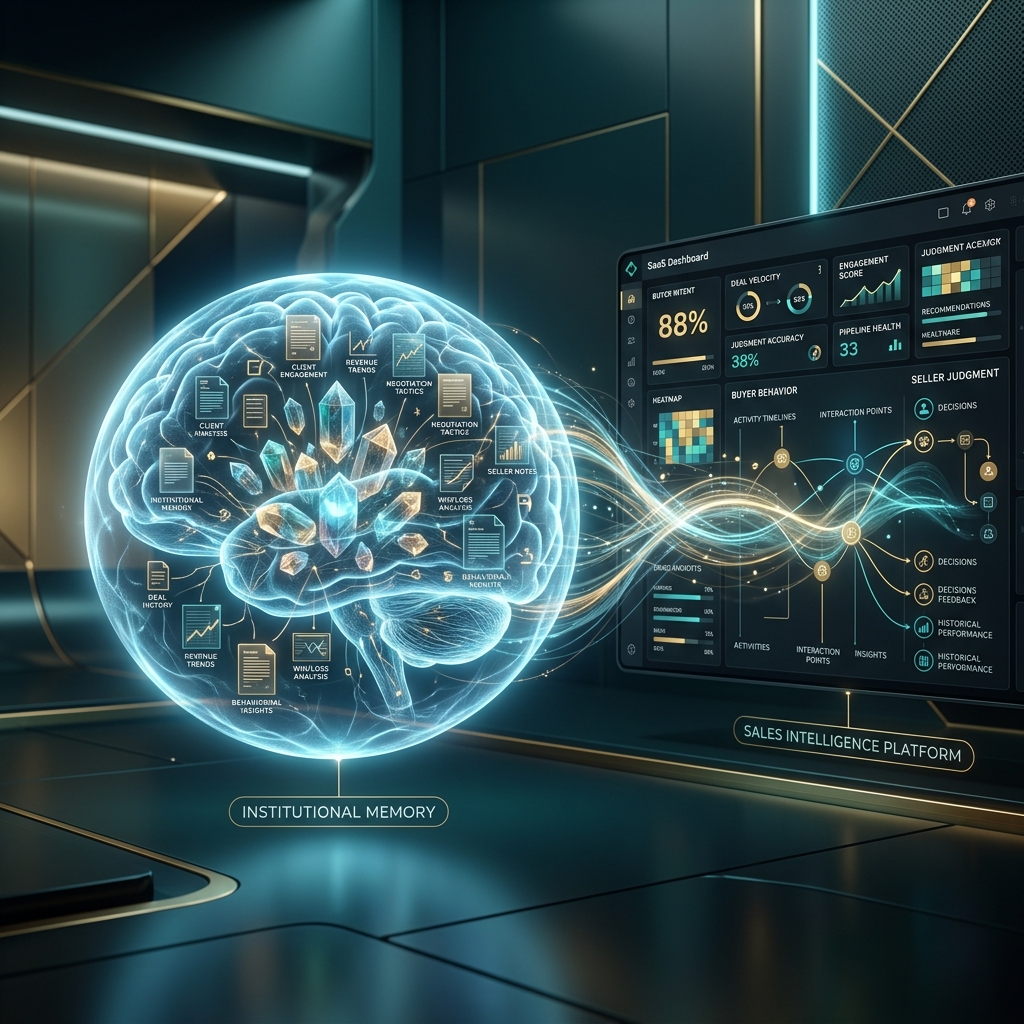
It is turning scattered human insight into institutional memory.
That means combining:
- Signals from calls and emails
- Stakeholder and engagement patterns
- Rep observations and intuition
- Manager assessments
- Historical deal outcomes
The objective is not to store more information.
It is to preserve commercial meaning. It's the logical next step for AI-native CRMs that model buyer intent rather than just documenting seller motion.
When anyone opens an opportunity, they should understand:
- Why the buyer may act now
- Where internal resistance exists
- Which relationships are strengthening
- What risks are increasing
- How confidence is changing over time
That is what institutional memory looks like in enterprise sales.
Where CopilotGTM fits
CopilotGTM is built around a simple premise.
The most valuable deal intelligence is usually known by the rep, but never captured because entering context into CRM feels like additional administrative work.
CopilotGTM reduces the friction required to record what sellers are actually seeing.
A rep can quickly document insights such as:
- Finance is pushing back
- The champion has lost influence
- Executive sponsorship is weakening
- Budget confidence is deteriorating
- Internal urgency is fading
CopilotGTM combines this human judgment with signals from meetings, emails, and stakeholder activity.
The result is a continuously updated commercial narrative rather than a disconnected set of tasks and notes.
Managers gain better inspection. Leadership gets more reliable forecasts. New account owners inherit the real context.
Most importantly, critical deal knowledge stops disappearing.
The real competitive shift in CRM
Traditional CRM systems were systems of record.
AI-native CRM systems are becoming systems of understanding. Their job is to surface how buying decisions are actually made while there is still time for a rep to influence the outcome.
Their job is no longer limited to documenting what happened.
Their job is to preserve what the organization has learned.
That shift changes the purpose of the CRM.
It becomes institutional memory for the commercial team.
And the companies that build this best will have a significant advantage.
Because in enterprise sales, the most valuable asset is not the activity history.
It is the collective judgment about what is really happening inside the deal.
FAQs
Common questions
What is institutional memory in sales?
Institutional memory is the preservation of the commercial story and judgment behind a deal—such as why a buyer is acting now or where internal resistance lies—beyond just a chronology of meetings.
Why does commercial context leak in traditional CRM?
Most predictive insights are shared in informal channels (Slack, one-on-ones) and feel too administrative to enter into a CRM, so they stay in the rep's head and disappear when they leave.
How does AI-native CRM capture human judgment?
It reduces the friction for reps to record observations (e.g., 'champion losing influence') and combines this intuition with meeting and email signals to create a continuous commercial narrative.
How does institutional memory improve forecasting?
By providing visibility into invisible organizational conviction and political risk, managers can make probabilistic assessments based on the actual deal reality rather than just activity volume.
Related reading
Continue exploring deal execution
CRM Stage Movement vs the Real Buyer Decision Process
Stage movement can hide how a buying decision is actually being made. Learn how to separate CRM progress from buyer-side alignment.
Buyer Intent Signals vs Seller Activity in Traditional CRM
Traditional CRM tracks seller activity, but buyer intent lives in stakeholder behavior, engagement quality, and decision signals across the account.
Confidence Is Not Evidence: Why Commit Deals Miss the Forecast
Why commit deals often miss the forecast and how organizations can shift from subjective seller confidence to objective buyer-side milestones for accuracy.
Deal Memory vs CRM Data: Why Handoffs Break Enterprise Deals
CRM data shows fields and activity, but deal memory preserves reasoning, stakeholder context, and decisions that keep enterprise deals alive through handoffs.
Warm Introductions in Buying Committees: How to Reach New Stakeholders
Cold outreach can reset trust inside active deals. Learn how warm introductions help sales teams enter new buying-group nodes with context.