
What Is a Deal Execution Platform? How It Differs From CRM

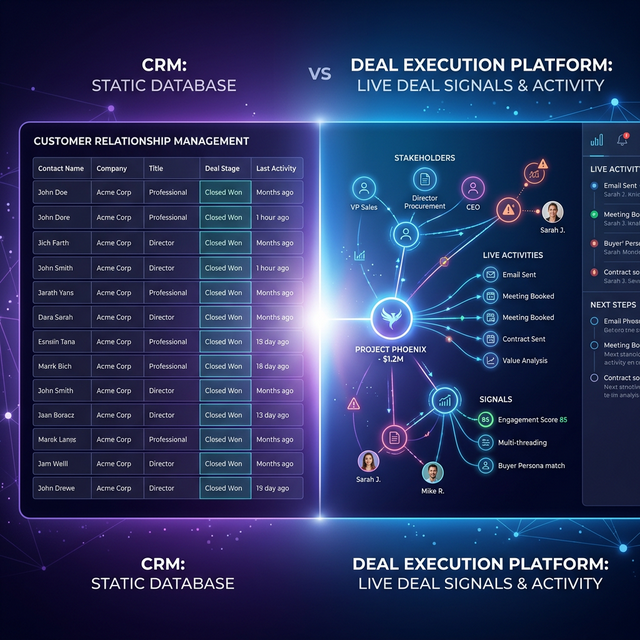
Key takeaways
- A deal execution platform is the operating layer that helps revenue teams understand deal reality, buyer progress, risks, and next actions.
- CRM is still the system of record, but it usually depends on rep-entered stages, fields, and activity history.
- Deal execution platforms connect CRM data with call context, stakeholder engagement, mutual plans, risks, and buyer-side milestones.
- The biggest difference is actionability: CRM records what happened, while deal execution helps teams decide what to do next.
A deal execution platform is software that helps revenue teams run active deals by tracking buyer progress, stakeholder engagement, risks, next actions, and the context behind every opportunity. It does not replace CRM. It sits above CRM and turns scattered deal data into execution guidance.
That difference matters because most revenue teams already have plenty of data. What they lack is deal reality.
CRM can tell you what stage a rep selected. It usually cannot tell you whether the buyer has completed the internal work required to purchase, whether legal is actually engaged, whether the CFO has gone silent, or whether the next step is strong enough to protect the forecast.
That is the gap a deal execution platform is designed to close.
What Is a Deal Execution Platform?
A deal execution platform gives sales, sales engineering, RevOps, and revenue leadership one operating view of how a deal is actually moving.
It connects information from systems such as CRM, calls, emails, meetings, notes, mutual action plans, stakeholder maps, and deal reviews. Then it helps the team answer questions that CRM fields alone cannot answer:
- Is the buyer actually progressing?
- Which stakeholders are engaged, missing, or going quiet?
- What risks are forming before the deal slips?
- What proof do we have for the forecast category?
- What action should the team take next?
In short, a deal execution platform is the layer between pipeline data and revenue action.
Related reading: Execution Intelligence: The Next Revenue Infrastructure.
CRM vs Deal Execution Platform
CRM is still important. It is the system of record for accounts, contacts, activities, stages, owners, and pipeline. The issue is that CRM was not designed to explain live deal movement.
| Area | CRM | Deal execution platform | | --- | --- | --- | | Primary role | System of record | System of execution | | Main question | What is logged? | What is actually happening? | | Deal stage | Usually rep-selected | Compared against buyer-side progress | | Forecast input | Stage, amount, close date, manager judgment | Evidence, risk signals, stakeholder coverage, next actions | | Context | Scattered across notes, fields, and tools | Unified into one deal view | | Risk detection | Manual review | Proactive signal detection | | Stakeholder visibility | Contact list and activity history | Engagement, influence, gaps, and silence | | Team guidance | Static fields and dashboards | Recommended actions and coaching prompts |
The practical difference is this:
CRM records the deal. A deal execution platform helps the team execute the deal.
Why CRM Is Not Enough for Modern B2B Deals
Modern B2B deals are rarely linear. A deal can look healthy in CRM while the buyer is internally stuck.
Common examples:
- The champion is responsive, but the economic buyer has not engaged.
- The deal is marked as "commit", but legal has not started review.
- A technical validation is complete, but procurement has not seen a business case.
- The rep has a next meeting, but there is no clear decision process.
- The close date is this month, but no buyer-side milestone supports that date.
This is why many forecast misses do not come from obviously weak deals. They come from deals that look convincing until the buying process exposes missing work.
We wrote more about this in Confidence Is Not Evidence: Why Commit Deals Miss the Forecast.
What Signals Should a Deal Execution Platform Track?
A useful deal execution platform should track signals that show whether the buyer is really advancing.
Important signals include:
- Stakeholder coverage: Are finance, legal, security, procurement, technical users, and the economic buyer involved where needed?
- Engagement quality: Are the right stakeholders speaking, replying, attending, and taking action?
- Buyer-side milestones: Has the buyer completed security review, budget approval, legal review, technical validation, and internal alignment?
- Momentum changes: Has engagement slowed down after a strong meeting?
- Single-threading risk: Is the team relying on one champion to carry the entire deal?
- Forecast evidence: Does the deal have objective proof for the current forecast category?
- Next action quality: Is the next step specific, mutual, and tied to buyer progress?
CRM may contain pieces of this information, but it usually does not connect them into a clear execution view.
Related reading: Detecting Deal Risks: Moving Beyond Happy Ears to Actual Progress.
Who Needs a Deal Execution Platform?
A deal execution platform is most useful when deals are complex enough that stage tracking is not enough.
It is especially relevant for:
- B2B SaaS companies with multi-stakeholder buying committees
- Revenue teams with long or technical sales cycles
- Sales engineering and presales teams that carry important deal context
- RevOps teams trying to improve forecast quality
- Sales leaders dealing with late-stage slips
- Teams where CRM updates are inconsistent or too shallow for coaching
If your sales motion is simple, transactional, and short, CRM may be enough. But if deals require internal buyer alignment, technical validation, procurement, legal, and executive approval, you need a stronger operating layer.
How CopilotGTM Fits This Category
CopilotGTM is built around this deal execution problem.
The goal is not to create another place for reps to manually update fields. The goal is to help revenue teams see the real state of a deal by connecting deal context, stakeholder activity, execution signals, risks, and next actions.
That means teams can move from subjective deal reviews to evidence-based execution:
- Instead of asking, "How do we feel about this deal?"
- Ask, "What buyer evidence supports this deal?"
- Instead of asking, "What stage is it in?"
- Ask, "What still has to happen for the buyer to move forward?"
That shift is the foundation of better forecast quality and stronger deal coaching.
For a related breakdown, read CRM Data vs Deal Memory: Why Revenue Teams Lose Deal Reality and Why CRM Stages Don't Reflect Real Buying Readiness.
Final Takeaway
CRM is necessary, but it is not the full operating system for modern revenue execution.
A CRM tells you where a deal has been logged. A deal execution platform helps you understand where the deal actually stands, what is missing, and what the team should do next.
That is the core difference between pipeline administration and deal execution.
FAQs
Common questions
What is a deal execution platform?
A deal execution platform is software that helps revenue teams manage active deals by tracking buyer progress, stakeholder engagement, risk signals, mutual action plans, and next best actions across the sales cycle.
Is a deal execution platform a replacement for CRM?
No. A deal execution platform usually works with CRM. CRM remains the system of record, while the deal execution platform adds context, execution signals, and guidance for live opportunities.
How is deal execution different from sales forecasting?
Forecasting estimates whether revenue will close. Deal execution focuses on what is happening inside each opportunity and what the team should do to move the buyer forward.
Who needs a deal execution platform?
Revenue teams with complex B2B sales cycles, multiple stakeholders, technical validation, legal review, security review, procurement, or frequent late-stage deal slips benefit most from a deal execution platform.
Related reading
Continue exploring deal execution
Why CRM Stages Don't Reflect Real Buying Readiness
Most sales teams trust their CRM stages more than they should. Learn why CRM stages track seller progress, not buyer readiness, and how that gap leads to forecast surprises.
Deal Risk Detection: How to Move Beyond Happy Ears
Happy ears hide forecast risk. Learn how to detect deal risk using stakeholder behavior, silence, momentum loss, and buyer-side progress signals.
Confidence Is Not Evidence: Why Commit Deals Miss the Forecast
Why commit deals often miss the forecast and how organizations can shift from subjective seller confidence to objective buyer-side milestones for accuracy.
Deal Memory vs CRM Data: Why Handoffs Break Enterprise Deals
CRM data shows fields and activity, but deal memory preserves reasoning, stakeholder context, and decisions that keep enterprise deals alive through handoffs.
CRM Stage Movement vs the Real Buyer Decision Process
Stage movement can hide how a buying decision is actually being made. Learn how to separate CRM progress from buyer-side alignment.