
Stakeholder Mapping for Multi-Threaded B2B Sales

Key takeaways
- Stakeholder mapping helps revenue teams see who is involved, who is missing, and who can influence or block the buying decision.
- Multi-threaded sales only works when each thread is connected to the same deal narrative and decision process.
- Coverage gaps often appear late because CRM contact lists do not show real engagement, influence, or silence.
- A live context graph can help teams track stakeholder roles, engagement quality, blockers, and next actions across the buying group.
In modern B2B SaaS, the era of the single "hero champion" driving a deal from introduction to signature is over.
Gartner reports that the average complex enterprise buying committee now involves 6 to 10 decision-makers. Each of these stakeholders, from the end-user champion to the CFO, IT Security, and Procurement, has their own motivations, concerns, and veto power.
If your sales and revenue teams are "single-threaded" (only communicating with one or two people), your deal is fundamentally at risk.
The Challenge of Tracking Engagement
Knowing you need to multi-thread is easy; actually tracking it across a 6-month sales cycle is incredibly difficult.
Context lives scattered across:
- Calendar invites
- CRM contacts
- Email threads
- Zoom call transcripts
When an Account Executive or Sales Engineer prepares for a critical deal review, they often have to piece this together manually. Has the CFO actually engaged in the last 30 days? Did Security approve the architecture review? This fragmented reality leads to blind spots.
The Power of a Live Context Graph
To master multi-threading, revenue teams are turning to Deal Execution Platforms that provide a live context graph for every deal.
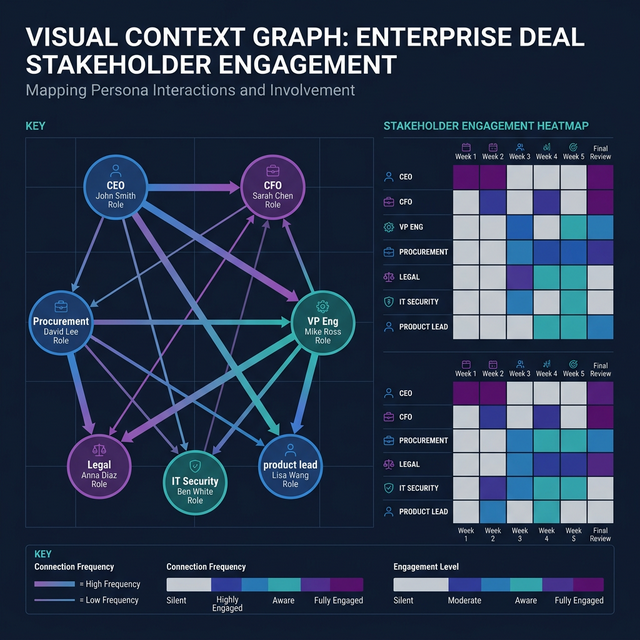
Instead of a static list of names in a CRM, a context graph visually maps the account:
1. Identifying the Gaps
A visual stakeholder map instantly reveals who is missing. You might have great engagement with the engineering team, but if the nodes for Legal and Finance are empty, the platform flags this coverage gap long before the end of the quarter.
2. Measuring Real Engagement
Not all stakeholders are created equal, and not all meetings mean engagement. An execution system measures the temperature of the relationship.
- Are they opening emails?
- Are they speaking on calls?
- When was the last direct interaction?
If a key influencer goes silent for 19 days, the context graph highlights them as a "warm" or "slipping" risk.
3. Understanding Influence and Blockers
A true execution platform tracks relevancy. It understands who reports to whom, who holds the budget, and who has historically acted as a blocker in similar deals. It elevates this intelligence so revenue teams can proactively guide the narrative.
A Unified Execution View
Mapping stakeholders is not a one-time exercise done on a whiteboard. It must be a living, breathing part of your execution system.
By unifying your CRM, conversational intelligence, and activity data into a single execution view, revenue teams can map stakeholder engagement per deal effortlessly. You will always know exactly who is engaged, what is missing, and what action to take next to build the consensus required to close.
FAQs
Common questions
What is stakeholder mapping in B2B sales?
Stakeholder mapping is the process of identifying the people involved in a buying decision, understanding their roles and influence, and tracking how engaged each person is throughout the deal.
Why does multi-threaded selling need stakeholder mapping?
Multi-threaded selling creates more conversations, but without a stakeholder map those conversations can become disconnected. Mapping keeps the team aligned on who matters and what each stakeholder needs.
What should a stakeholder map track?
A useful stakeholder map should track decision roles, influence, blockers, engagement level, last interaction, relationship owner, and missing personas such as finance, legal, security, or the economic buyer.
Related reading
Continue exploring deal execution
Deal Risk Detection: How to Move Beyond Happy Ears
Happy ears hide forecast risk. Learn how to detect deal risk using stakeholder behavior, silence, momentum loss, and buyer-side progress signals.
The Inspiration Behind CopilotGTM: Empowering the Next Era of Sales Engineering
From three founders who worked closely with presales teams, learn how CopilotGTM was born to bridge the gap between SEs' strategic potential and operational enablement.
Buyer Intent Signals vs Seller Activity in Traditional CRM
Traditional CRM tracks seller activity, but buyer intent lives in stakeholder behavior, engagement quality, and decision signals across the account.
Stakeholder Engagement vs Meeting Attendance in Buying Groups
Meeting attendance does not equal stakeholder engagement. Learn why silent buyers create hidden deal risk inside complex buying groups.
AI RevOps Teammate: Continuous Deal Monitoring for Revenue Teams
An AI RevOps teammate monitors deal risk, stakeholder gaps, follow-through, and pipeline health continuously instead of relying on manual reviews.