
Decision Ownership in B2B Sales: Why Deals Stall Without an Internal Owner

Key takeaways
- Momentum often dies not from a 'no', but from a lack of clear decision ownership.
- Pushing is not the same as owning: ownership means driving alignment, resolving disagreements, and forcing prioritization.
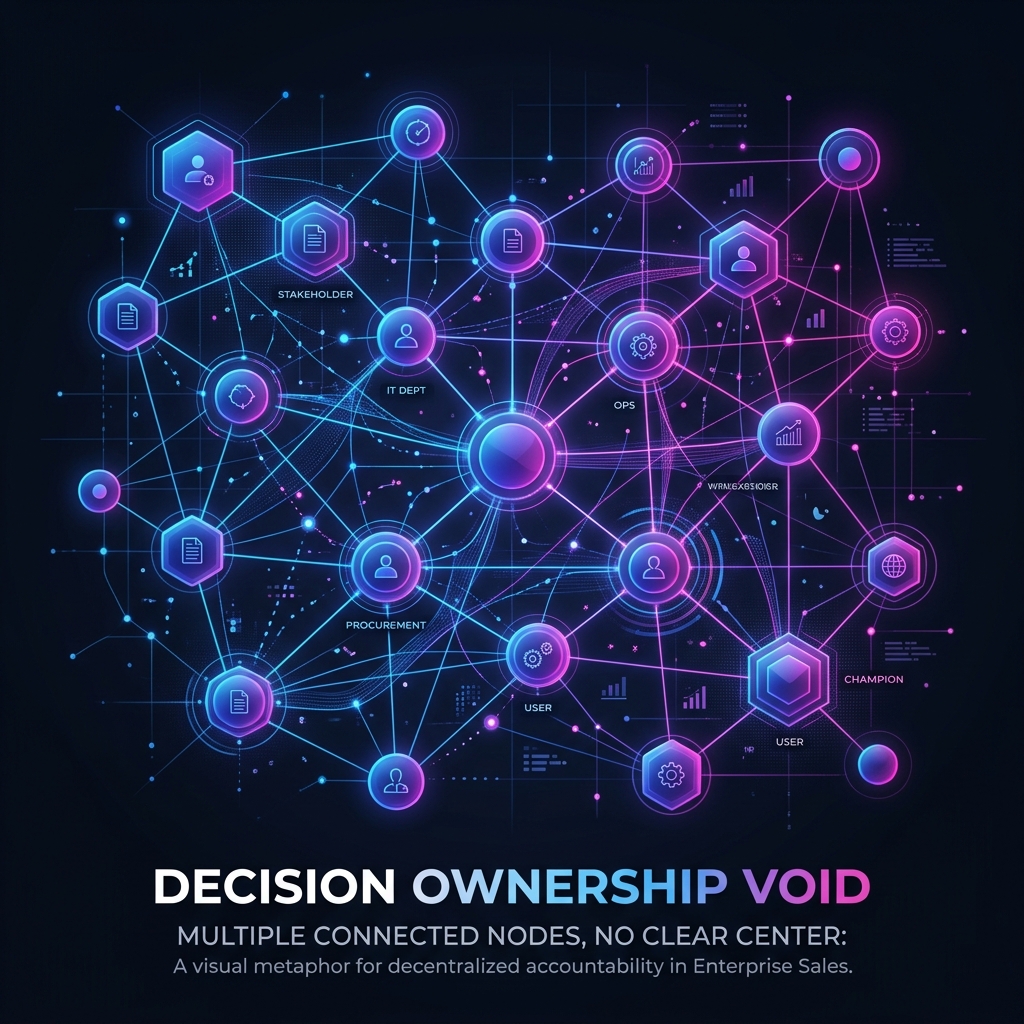
- When multiple stakeholders are involved without a designated owner, everyone assumes someone else will drive the deal.
- Track ownership, not just engagement, to prevent deals from stalling in a loop of follow-ups.
What is happening
In most enterprise deals, momentum doesn’t die in a dramatic “no.” It fades.
Calls keep happening. Stakeholders stay polite. Everyone agrees the problem matters.
But nothing moves.
The deal sits in a quiet loop of follow-ups, internal discussions, and vague next steps.
From the outside, it looks like a complex decision taking time.
In reality, the buying group has no clear owner of the decision.
Why this happens in real deals
Enterprise buying groups are not designed for clean ownership.
Multiple stakeholders are involved for valid reasons:
- Business leaders care about outcomes
- Technical teams care about feasibility
- Procurement cares about cost and process
- Legal cares about risk
But none of them are explicitly accountable for driving the decision forward.
Your “champion” might be pushing, but pushing is not the same as owning.
Ownership means:
- Driving internal alignment
- Resolving disagreements
- Forcing prioritization against other initiatives
Most stakeholders don’t have the mandate, incentive, or political capital to do all three.
So what happens instead?
Everyone participates, but no one actually engages to decide.
Realistic scenario
A VP of Operations is engaged and clearly sees the value.
They bring in IT for evaluation. IT is positive but cautious.
Finance is looped in later and asks for ROI validation.
Procurement enters with standard process requirements.
Each group is doing their job correctly.
But no one is actually responsible for getting the deal done.
The VP assumes IT will validate quickly. IT assumes the VP will push priority. Finance waits for a stronger business case. Procurement waits for formal approval to proceed.
From your side, it feels like momentum is slowing for no clear reason. This is an example of how momentum gets rewritten by inaction rather than direct opposition.
Inside the account, the deal has no owner.
What it means for sales teams
Most sales processes are built around tracking engagement, not ownership.
You can have:
- Multiple stakeholders on calls
- Positive feedback across functions
- Clear problem-solution fit
And still have zero progress.
Because activity is not progress, and progress requires someone inside the account to take responsibility for the decision.
If that ownership is missing:
- Alignment won’t convert into action
- Timelines won’t hold
- Priorities will shift silently
This is why “next steps” often slip without resistance. And momentum dies in the gap between meetings.
Not because the deal is weak.
Because no one is accountable for moving it forward.
Until ownership is clear, the deal is structurally stalled, no matter how strong it looks on the surface.
FAQs
Common questions
Why do deals stall when there is positive feedback from all stakeholders?
Because positive feedback doesn't equal progress. Progress requires an internal owner to explicitly drive alignment, prioritize the project against other initiatives, and push the decision through.
What is the difference between a champion and a decision owner?
A champion might advocate for the solution, but a decision owner has the political capital and mandate to resolve internal disagreements and actually force a timeline.
How can sales teams identify a lack of ownership?
Watch out for 'next steps' that slip without resistance, vague responses on timelines, and scenarios where each department is waiting on another to act first.
Related reading
Continue exploring deal execution
Sales Activity vs Buyer Progress: Why Busy Deals Still Slip
High activity can hide weak buyer progress. Learn why meetings, emails, and Slack threads do not prove a deal is moving toward a decision.
Multi-Threaded Sales Without Narrative Control Creates Deal Risk
Multi-threading can create disconnected stakeholder conversations. Learn how narrative control keeps buying groups aligned around one decision.
Deal Context in Sales Conversations: Why CRM Summaries Miss Critical Signals
Critical deal context often lives in customer conversations, not CRM summaries. Learn why signals get lost and how that creates unpredictable deals.
Why Static CRM Snapshots Create Hidden Deal Risk
CRM snapshots freeze a deal at one moment, but buyer priorities, stakeholders, and risks keep changing. Learn why static deal views mislead teams.
Hidden Stakeholders in B2B Buying Groups: The Mapping Problem
Hidden stakeholders create late-stage objections because they were never mapped early. Learn how buying group blindness derails enterprise deals.